Digital
CDHD - Communication and learning Helper for Deaf and Hearing people
Application for Hololens to aid Deaf people in learning and in communicating with hearing people.
Project developed during the Usability Engineering Masters course together with Pimchanok Sripraphan and Vivien Nwoye (2017).
Participated of the Accessathon - Hackathon for disabilities in Rhein-Waal University.
Digital
CDHD - Communication and learning Helper for Deaf and Hearing people
Application for Hololens to aid Deaf people in learning and in communicating with hearing people.
Project developed during the Usability Engineering Masters course together with Pimchanok Sripraphan and Vivien Nwoye (2017).
Participated of the Accessathon - Hackathon for disabilities in Rhein-Waal University.
UX/UI

OLSK
How might we generate easy-to-follow and easy-to-access machine assembly guidelines semi-automatically?
Project Description
Starting a digital fabrication workshop requires a set of machinery, which is often imported and unaffordable. The Open Lab Starter Kit (OLSK) is an InMachines project in cooperation with Fab City Hamburg, which aims at creating a repository of open-source machines to be replicable locally and with lower costs.
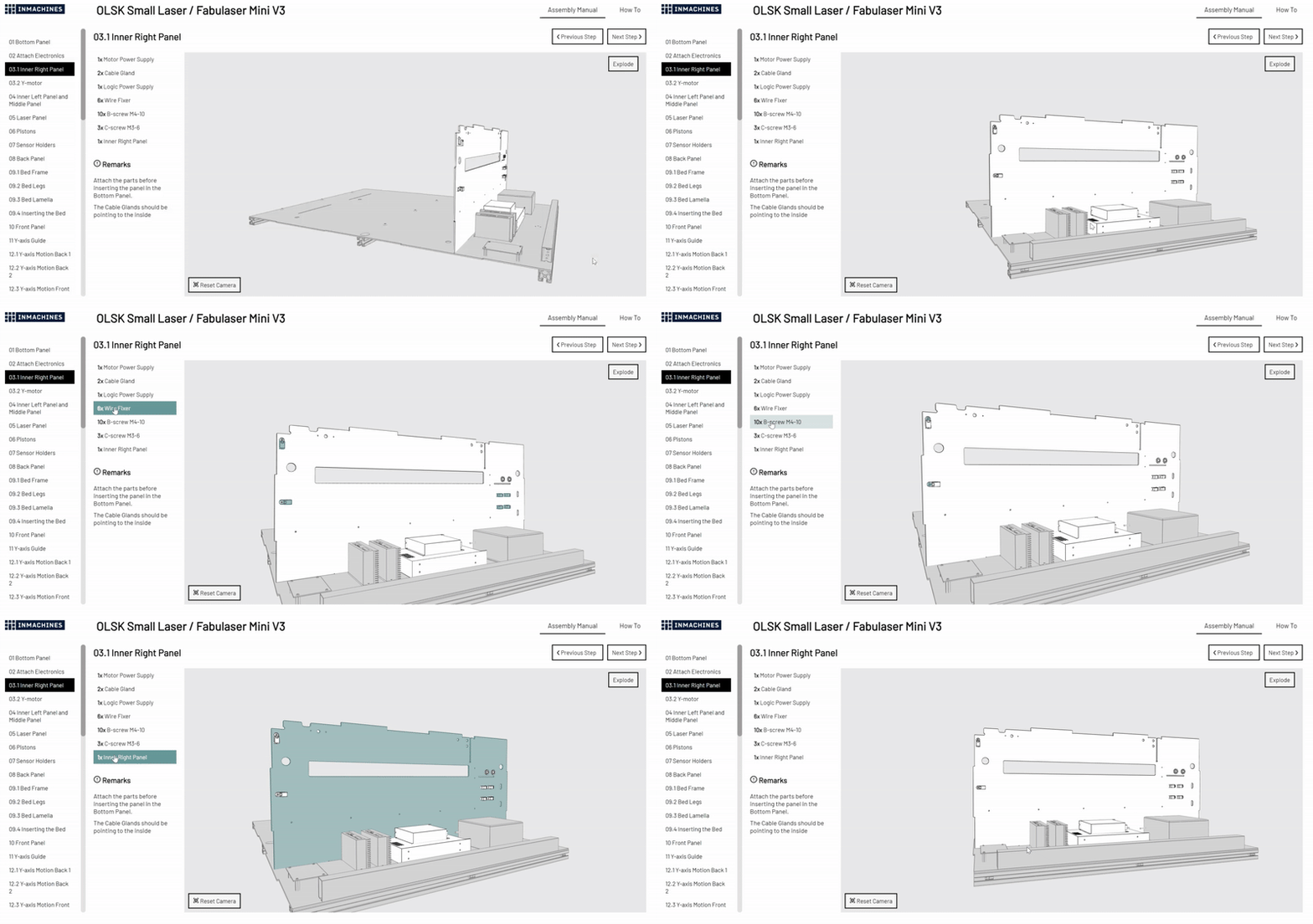
The documentation of these open-source machines needs to include their assembly manual. To create these assembly manuals as time-efficiently as possible, we developed a system that generates these documents semi-automatically online and on an easy-to-follow 3D-interactive interface.
My role
End-to-end Product Design
User Research
UX/UI Design
Wireframing
Instructional Design
Development & Deployment
User Testing
Documentation Specialist
Tools
Javascript
HTML
CSS
React
R3F
ThreeJS
Rhinoceros 3D
GitHub
Timeframe
2022 - 2024
The process
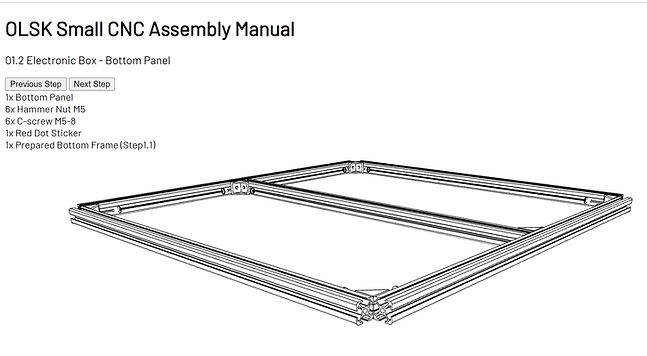
The precedent project Fabulaser resulted in a high-quality assembly manual, but limited in scalability, since it was created in InDesign, page by page, meaning a small change in the machine demanded the recreation of several pages.
Throughout the several machine assembly workshops, the needs and difficulties of users were observed and noted.
After brainstorming and discussions, a list of desirable features was created, adding their priority according to level of importance to the usability.
It was then necessary to implement the basic functionalities in the code to test the technical viabilities of our concept: the display of parts list, the navigation of steps, the interactive 3D model and the assembly "motion" represented by an exploded view.

.jpg)
The functionalities and interface were implemented in parallel in several iterations, and validated by users to gather feedback.
In addition to the basic functionalities mentioned previously, they included the highlighting of the clicked part for better identification, the assembly step menu and a how-to section with animations to assist the user in complicated steps.
As an outcome, this assembly manual not only provides a smooth machine assembly to the user with clear visual instructions, but it is also innovative, open-source and efficient. The system automatically generates the list of assembly steps, calculates and displays the parts list using the 3D model file as source.